From Remediation to Resilience
Making Operational Excellence a Competitive Strategy

Article 8 of 9 | The Knowledge Stack | Jason Tilley
Opening
There is a pattern that repeats itself in organizations that successfully complete a major operational improvement initiative. The assessment findings get addressed. The highest-priority processes get documented. Knowledge gets transferred. Integrations that had been deferred for years finally get implemented. Leadership celebrates, and rightly so. The work was real and the results are measurable.
Then, eighteen months later, someone on the operations team notices that a new workaround has taken root in the loan origination department. A key employee in member services has become the de facto owner of a process that exists nowhere in writing. A vendor relationship that should have been integrated into the core system is instead generating a daily spreadsheet that three people manually reconcile each morning.
The debt is back.
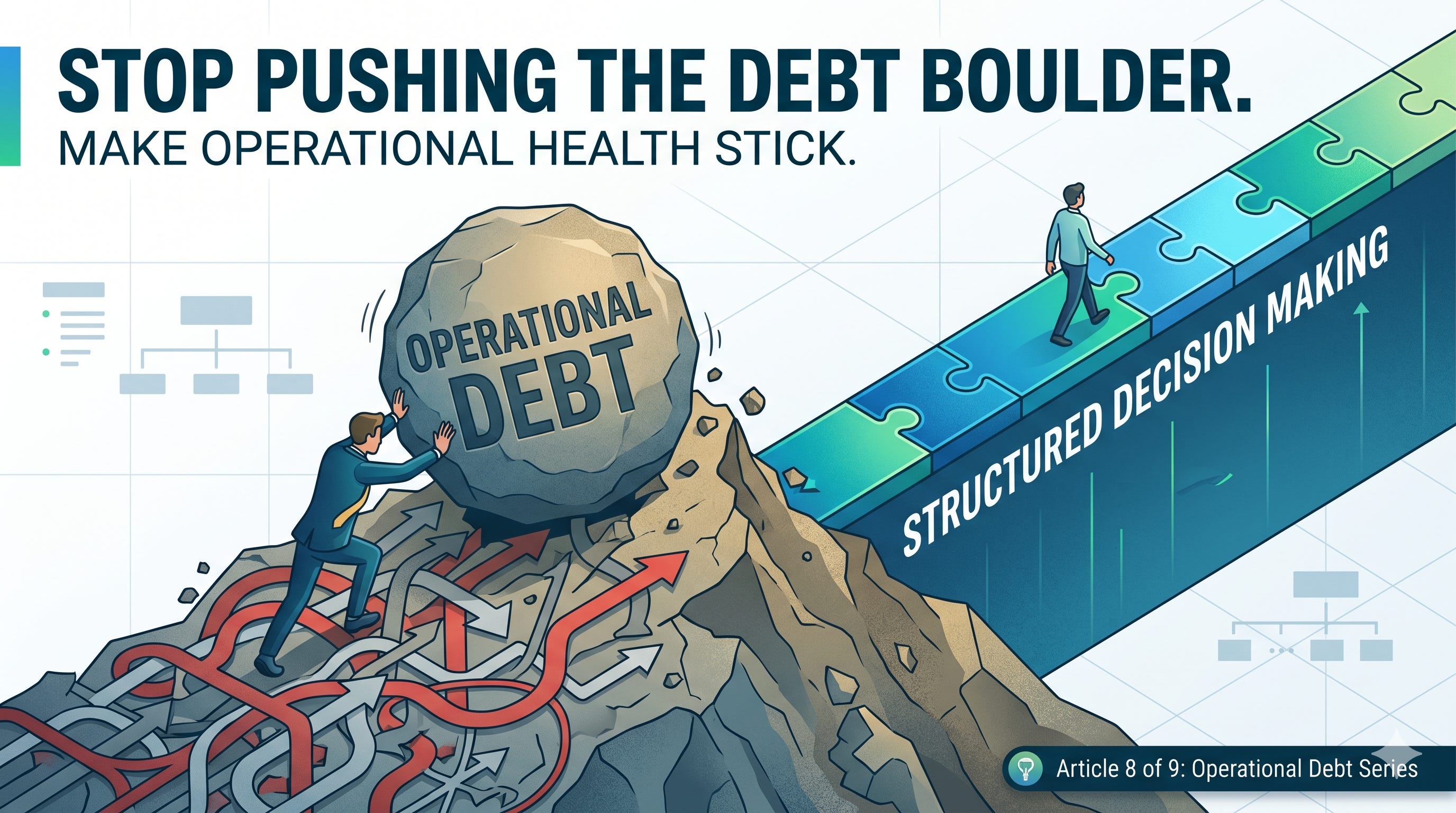
This is not a failure of the remediation effort. It is the predictable result of treating operational debt as a project rather than a condition. Projects have endpoints. Conditions require ongoing management. The credit unions that sustain operational health over time are not the ones that run the most thorough cleanup initiatives -- they are the ones that change how decisions get made, how processes get approved, and what the organization visibly values on an common Tuesday.
That distinction is the subject of this article.
Paying down operational debt is necessary. Stopping there is not enough. The organizations that sustain operational health are the ones that make excellence a deliberate competitive strategy.
Why Debt Re-Accumulates
Operational debt does not return because employees are negligent or because leadership stops caring. It returns because the organizational conditions that originally produced it are still present. Expediency still exists. Competing priorities still crowd out documentation. Vendor timelines still slip. Good employees still solve problems in ways that work today and create obligations tomorrow.
Without structural change, remediation efforts amount to draining a bathtub while the faucet is still running. The rate of outflow may temporarily exceed the rate of inflow, but the system is unchanged. Given enough time and enough new decisions made under pressure, the tub fills again.
The organizations that break this cycle are not necessarily larger or better resourced than those that do not. They share a different orientation: they treat operational excellence as a strategic capability that requires the same governance, investment, and leadership attention as any other competitive function. Member growth gets a strategy. Technology gets a roadmap. Operations, in most credit unions, gets a cleanup effort every few years.
That asymmetry is the root cause.
Governance as the Load-Bearing Wall
Culture gets most of the credit when organizations sustain operational excellence over time. Culture matters, and the next section addresses it directly. But culture without structure is aspiration. The credit unions that avoid re-accumulation build accountability architecture first -- defined ownership, documented standards, and operational metrics that travel to the same rooms as financial ones.
Governance in this context does not mean bureaucracy. It means answering three questions clearly and keeping those answers current: Who owns this process? What does “done correctly” look like? How will we know if it degrades?
Process ownership is the foundation, and cross-functional processes are where it breaks down most often. Most credit unions can identify who manages a department. Fewer can identify who owns a specific process: who is accountable for its documentation, its performance, and its improvement over time. Those are different responsibilities, and conflating them is how processes drift. When a process belongs to everyone, it effectively belongs to no one.
The challenge sharpens when a process crosses business unit boundaries. Member onboarding, for example, may touch retail, lending, compliance, and technology before it resolves. Each department manages its own piece. Nobody owns the end-to-end experience. Breakdowns at the handoff points are common, often invisible to anyone who only sees their portion of the workflow, and typically resolved through informal coordination that never gets documented.
APQC deals with this directly: because a process threads through multiple functions, ownership may be shared or unclear for many activities, and although these challenges exist, organizations need to assign owners to these processes so that they are governed by a single authority. Their guidance acknowledges that a C-suite executive often holds nominal accountability for cross-functional processes, but flags that this arrangement tends to fail at the working level, where measurement, benchmarking, and improvement conversations need to happen with people close enough to the work to act on them.
The research on cross-functional team performance accentuates the stakes. According to Harvard Business Review, 75% of cross-functional teams are dysfunctional, often missing deadlines, blowing budgets, or falling short of expectations. The most commonly cited culprit is not a lack of cooperation between departments, but a lack of clear accountability for outcomes. Ownership ambiguity carries measurable operational consequences.
When a process belongs to everyone, it effectively belongs to no one.
For credit unions building governance structures to prevent re-accumulation, the practical response is twofold. First, cross-functional processes require an explicitly named owner: a single person accountable for documentation currency, performance against defined benchmarks, and escalation when the process degrades. That owner need not be the most senior person involved. They need to be the person with the clearest line of sight to the full workflow and enough organizational standing to convene the relevant stakeholders when something needs to change.
Second, the handoff points between departments deserve their own documentation and their own accountability. This is where informal workarounds most reliably take root. A cross-functional process map that ends at departmental boundaries has not captured the process. It has captured each department’s interpretation of it, which leaves the most operationally significant territory undocumented.
Assigning named ownership, with explicit accountability for documentation currency and performance against defined benchmarks, is the single most durable structural change an organization can make to prevent re-accumulation. That ownership question belongs on the agenda before a process goes live, not after it has generated months of tribal knowledge.
Change governance closes the door that remediation opens. Operational debt accumulates fastest at the point of change: new product launches, system conversions, regulatory responses, and vendor transitions. These moments compress timelines and increase pressure, which are exactly the conditions that produce workarounds and undocumented decisions. A change governance standard that treats process documentation as a completion criterion rather than an afterthought keeps new debt from entering the system through the same channels that created the original backlog.
This does not require a formal program management office. It requires that “how will this process be documented and owned?” is a standard question on every project closeout, every vendor implementation, and every product launch. The question itself, asked consistently, changes behavior.
Operational metrics belong at the executive level. Financial performance reports to ALCO. Technology risk reports to the board. Operational health, in most credit unions, reports to no one in particular. That gap is structural, and it produces a predictable outcome: conditions that would concern leadership if they were visible remain invisible until they surface as a member complaint, a regulatory finding, or a staffing crisis.
The metrics do not need to be complex. Process documentation coverage rates, exception frequency by department, and manual intervention rates on key member-facing workflows are sufficient starting points. What matters is that these numbers appear on the same dashboards and in the same conversations as loan growth and net interest margin. Operational health becomes a priority when it is measured like one.
Culture as the Enforcement Mechanism
Governance creates the rules. Culture determines whether they are followed when no one is watching.
Credit unions can build process ownership frameworks, change governance standards, and executive-level operational dashboards, and still find themselves re-accumulating debt within two years. The difference between organizations that hold the line and those that drift back is rarely the quality of their governance documents. It is whether the people making decisions under pressure -- product managers launching ahead of schedule, operations staff absorbing a vendor delay, executives approving a workaround to meet a board deadline -- treat operational discipline as a real constraint or a negotiable one.
That answer is set by leadership behavior, not policy language.
What leaders model is what organizations internalize. When a senior leader approves a product launch without completed process documentation because the timeline is tight, they have communicated something more durable than anything in the employee handbook. They have communicated that documentation is what you do when things are easy, not when things are hard. That message travels fast and reshapes behavior at every level below it.
The reverse is equally true. Leaders who consistently ask “who owns this process?” before approving a new initiative, who return change requests that arrive without a documentation plan, and who visibly elevate operational metrics alongside financial performance, are shaping what their organizations treat as non-negotiable. It comes down to what questions get asked, repeatedly, in rooms where decisions are made.
Governance creates the rules. Culture determines whether they are followed when no one is watching.
This is ultimately an executive accountability. Governance frameworks do not sustain themselves. Culture does not shift because a consultant delivered a report or because a steering committee approved a new policy. It shifts when the people at the top of the organization treat operational discipline as a genuine leadership obligation rather than a project to complete and close out.
That distinction matters more than most executives acknowledge. It is common for organizations to fund an improvement initiative, celebrate its completion, and then redirect attention to the next strategic priority. The work feels done because the deliverables are finished. But the conditions that originally produced operational debt -- expediency under pressure, deferred documentation, ownership gaps at the cross-functional seams -- have not changed unless leadership continues to hold them. An executive team that treats operational excellence as a one-time effort will get one-time results.
The credit unions that sustain progress are the ones where senior leadership stays in the conversation: asking about process ownership in strategic planning sessions, treating operational metrics as a standing agenda item rather than a periodic report, and being willing to slow down a product launch or a vendor implementation when the governance criteria have not been met. That posture, sustained over time, is what makes a governance framework functional rather than decorative.
Funding and staffing signal organizational priorities more clearly than strategy documents. Credit unions that sustain operational excellence over time typically have dedicated operational improvement capacity -- not “other duties as assigned” capacity, not a committee that meets quarterly, but a person or a small team whose primary accountability is the health of the organization’s operational infrastructure. They have the standing to flag degradation, convene process owners, and escalate to leadership when governance standards are not being met.
That investment is the most legible signal an organization can send about whether operational excellence is a stated value or a funded one. The distinction matters to employees who are deciding how much friction to absorb before taking a shortcut.
Recognition reinforces what measurement alone cannot. Metrics create visibility. Recognition creates motivation. Organizations that make operational excellence a cultural reality find ways to acknowledge the work that prevents problems, not just the work that solves them. The employee who identifies and documents a fragile cross-functional handoff before it fails is doing something strategically significant. If that contribution is invisible in performance conversations while revenue-generating activity is celebrated, the culture has communicated a clear hierarchy of what matters.
Operational stewardship does not require new compensation structures or formal awards programs. It requires that leaders talk about it specifically and consistently, in the moments when it would be easier to focus only on outcomes.
The cultural marker to watch is how the organization handles the exception. Every credit union has governance standards on paper. The revealing moment is when a project is three weeks from launch and the process documentation is incomplete. Does the deadline move, or does the standard bend? That decision, made repeatedly across dozens of initiatives over several years, is what the organization’s culture actually is. Policy says one thing. Repeated behavior under pressure says another. Culture is the latter.
Operational Excellence as Competitive Positioning
Credit unions have spent the better part of two decades competing on member experience. Rates, convenience, digital access, and staff relationships have all been levers in that competition. Operational excellence has rarely been named as one of them, even when it is quietly determining the outcome.
That is beginning to change. The evidence is in where credit union executives are directing their attention. According to a recent Cornerstone Advisors report, nearly two-thirds of credit union executives now identify operational efficiency as one of their top concerns, alongside new member growth and deposit gathering. The Jack Henry 2025 Strategy Benchmark, which surveys bank and credit union CEOs on their priorities for the coming year, puts the shift in sharper relief: improving efficiency ranked among the most critical strategic areas for 2025 and 2026, described as no longer just a goal but a key imperative. Among the credit union leaders surveyed by CSI for their 2026 Banking Priorities report, 74% said their processes could be more efficient, and efficiency drivers like automation and better workflows ranked as the top technology investment priority for the year.
The strategic logic behind that shift is worth naming directly. Since the post-pandemic recovery, the emphasis across the industry has been on resilience. The current moment calls for a turn toward efficiency, while preserving a member-first orientation in an increasingly digital environment. Rising fraud losses, thinning margins, and steady membership attrition to fintechs have made operational drag a competitive liability rather than a background condition.
The connection between operational health and competitive positioning is direct. A credit union that operates cleanly -- with documented processes, distributed knowledge, integrated systems, and minimal manual intervention in member-facing workflows -- can do things its operationally burdened competitors cannot. It can onboard members faster, launch products with fewer internal dependencies, absorb regulatory changes without a scramble, and redeploy staff time toward relationships rather than reconciliation work. These are not peripheral advantages. They compound over time in the same way operational debt does, only in the opposite direction.
Member-facing speed is one of the more visible expressions of this. When a loan application requires manual data movement between systems because an integration was deferred, or when an account opening stalls because the process crosses three departments with no single owner, the member experience suffers in ways that rarely trace back to the underlying operational condition in any post-interaction survey. Members describe it as slow, or inconsistent, or requiring too many follow-up calls. The operational debt that produced the experience stays invisible. Only its effects reach the member.
74% of credit union leaders say their processes could be more efficient. The organizations that act on that structurally -- not episodically -- are building an advantage their competitors will find difficult to replicate quickly.
Regulatory resilience is a less discussed but equally significant advantage. Credit unions operating with high manual process accumulation and low documentation coverage absorb regulatory change poorly. New requirements land on top of existing workarounds, creating additional layers of informal procedure that rarely get captured anywhere. Examiners who ask for process documentation receive narrative descriptions of how things are supposed to work rather than evidence of how they actually do. Organizations with mature operational discipline absorb regulatory change as a normal process update. Those without it absorb it as a crisis.
Staff experience connects directly to member experience. When employees spend meaningful portions of their workday navigating workarounds, manually reconciling data across systems, or compensating for knowledge that was never formally transferred, they are not spending that time with members. The series has returned to this point across multiple articles because it remains underweighted in how credit unions think about operational improvement. Time recovered from manual process accumulation and integration avoidance is not primarily a cost savings. It is capacity that flows toward the relationships credit unions cite as their core competitive differentiator.
Operational excellence, framed this way, is not a back-office concern. It is the infrastructure that determines whether the credit union’s member-facing commitments are achievable at scale, consistently, across staff changes and system upgrades and regulatory cycles. The industry data suggests that executive awareness of this connection is growing. The credit unions that act on it structurally -- governing operational health the way they govern financial performance -- are building something their competitors will find difficult to replicate quickly.
What a Prevention-Oriented Organization Actually Looks Like
Frameworks are easy to describe and difficult to sustain. The gap between an organization that has documented its commitment to operational excellence and one that has actually built it tends to be invisible from the outside. From the inside, it is unmistakable.
The markers below are not aspirational. They are observable behaviors and structural conditions that distinguish credit unions where operational discipline has taken hold from those where it remains a project waiting to be completed.
Process ownership is assigned before a process goes live, not after. In prevention-oriented organizations, the question of who owns a process is settled during design, not during the first operational failure. New products, vendor implementations, and regulatory changes arrive with named process owners attached. Those owners understand they are accountable for documentation currency, performance monitoring, and escalation. This is not a formality. It is the organizational equivalent of not leaving a building without locking the door.
Documentation is a completion criterion, not a separate workstream. The most reliable indicator that an organization is still accumulating debt is a backlog of undocumented processes sitting alongside an active documentation initiative. In organizations that have broken the cycle, documentation is built into delivery. A process that cannot be documented has not been fully designed. A project that closes without documented workflows and assigned ownership has not actually closed.
Operational metrics appear on executive dashboards without being requested. When process health data, exception rates, and manual intervention frequencies travel to the same leadership conversations as loan growth and net interest margin, operational excellence has achieved institutional standing. It is no longer a department reporting upward on its own performance. It is a leadership concern, treated as such by the people who set organizational priorities.
Cross-functional processes have a single named owner and a documented handoff map. Member-facing workflows that cross departmental boundaries are the most common source of re-accumulation. In organizations that manage this well, these processes are explicitly mapped through every handoff point, owned by a specific individual with cross-functional standing, and reviewed on a defined schedule. The informal coordination that characterizes most cross-functional work has been made formal and visible.
New staff learn documented processes, not tribal knowledge. Onboarding is a reliable diagnostic. In organizations still carrying significant operational debt, new employees spend a disproportionate share of their early weeks learning workarounds from colleagues rather than from documentation. In prevention-oriented organizations, documented processes are the primary onboarding vehicle. Tribal knowledge still exists -- it always will -- but it supplements the formal record rather than replacing it.
The exception is handled consistently, regardless of who is watching. This is the marker that matters most and is the hardest to manufacture. When a project deadline arrives and the process documentation is incomplete, what happens? When a vendor implementation runs over schedule and the temptation to launch without a finalized ownership structure is real, what does leadership do? Prevention-oriented organizations have answered these questions enough times, consistently enough, that the answer has become organizational habit. The standard holds not because someone is enforcing it in the moment, but because the organization has internalized that bending it is more expensive than maintaining it.
None of these markers arrive fully formed. They develop through accumulated decisions, made by leaders who treat operational discipline as a genuine obligation rather than a periodic initiative. The credit unions that reach this point have not necessarily invested more than their peers. They have sustained the investment differently -- continuously, visibly, and with the expectation that operational health is as much a leadership responsibility as financial performance.
A process that cannot be documented has not been fully designed. A project that closes without documented workflows and assigned ownership has not actually closed.
Where Does Your Organization Stand?
The following questions are intended for honest internal review, not benchmarking. They surface the structural and behavioral conditions that determine whether operational excellence holds after remediation.
1. Can you name the single accountable owner of your three most critical cross-functional processes -- not the department, but the individual?
2. When were those cross-functional processes last reviewed end-to-end, including all handoff points between departments?
3. What happens to your documentation standards when a project is running behind schedule? Does the deadline move, or does the standard bend?
4. Do operational health metrics -- process documentation coverage, exception rates, manual intervention frequency -- appear regularly in executive-level reporting?
5. How do new employees learn your most important member-facing processes? From documentation, or from colleagues?
6. Is operational improvement staff a dedicated function with clear accountability, or is it distributed across existing roles as an additional responsibility?
7. If your organization has been through a prior remediation effort, what structural change was made afterward to prevent re-accumulation -- and is that change still active?